Accueil › TCS › Devoir surveillé n°1

Devoir surveillé n°1

Arithmétique, calcul vectoriel et projection

Chargement du PDF…

Remarque — barème

Exercice 1 sur 12 points, exercice 2 sur 5 points, exercice 3 sur 3 points (total 20 points). Les points de chaque question sont indiqués entre crochets. Deux questions bonus (+0,5 pt chacune) permettent de compenser une erreur ; la note est plafonnée à 20.

Exercice 1 — Notions d’arithmétique — 12 points Moyen ★★★☆☆

  1. On considère les entiers naturels a=4200a=4200 et b=4410b=4410. a) En utilisant la méthode de décomposition, montrer que a=23×3×52×7a=2^3\times3\times5^2\times7 et que b=2×32×5×72b=2\times3^2\times5\times7^2. [2 pts] b) En déduire PGCD⁡(a;b)\operatorname{PGCD}(a;b) et PPCM⁡(a;b)\operatorname{PPCM}(a;b). [2 pts] c) Écrire ab\dfrac ab sous forme irréductible, calculer ab+121\dfrac ab+\dfrac1{21} et simplifier a×b\sqrt{a\times b}. [2 pts]

  2. On considère un entier naturel nn, et les nombres A=3n+2+3nA=3^{n+2}+3^n et B=5×2n+1+2n+3B=5\times2^{n+1}+2^{n+3}. Montrer que AA est un multiple de 1010 et que 99 divise BB. [2,5 pts]

  3. Le nombre 337337 est-il premier ? Justifier. [1,5 pt]

  4. On considère un entier impair nn. Montrer que n2+7n^2+7 est un multiple de 88. [2 pts]

    Bonus [+0,5 pt]. En déduire que, pour tout entier impair nn, le nombre n4−1n^4-1 est un multiple de 1616.

Voir la correction

1) a) [2 pts] Divisions successives [1 pt par décomposition] :

Quotients de aa42004200210021001050105052552517517535357711
Diviseurs premiers22222233555577
Quotients de bb441044102205220573573524524549497711
Diviseurs premiers223333557777

Donc a=23×3×52×7a=2^3\times3\times5^2\times7 et b=2×32×5×72b=2\times3^2\times5\times7^2.

1) b) [2 pts] PGCD⁡(a;b)=2×3×5×7=210\operatorname{PGCD}(a;b)=2\times3\times5\times7=210 [1] ;  PPCM⁡(a;b)=23×32×52×72=88 200\ \operatorname{PPCM}(a;b)=2^3\times3^2\times5^2\times7^2=88\,200 [1].

1) c) [2 pts] ab=23×3×52×72×32×5×72=22×53×7=2021\dfrac ab=\dfrac{2^3\times3\times5^2\times7}{2\times3^2\times5\times7^2}=\dfrac{2^2\times5}{3\times7}=\dfrac{20}{21} [0,5] ;  ab+121=2121=1\ \dfrac ab+\dfrac1{21}=\dfrac{21}{21}=1 [0,5].

a×b=24×33×53×73=(22×3×5×7)2×3×5×7a\times b=2^4\times3^3\times5^3\times7^3=(2^2\times3\times5\times7)^2\times3\times5\times7, donc a×b=420105\sqrt{a\times b}=420\sqrt{105} [1].

2) [2,5 pts] A=3n×32+3n=3n(9+1)=10×3nA=3^n\times3^2+3^n=3^n(9+1)=10\times3^n, avec 3n∈N3^n\in\mathbb{N} : AA est un multiple de 1010 [1,25].

B=5×2×2n+23×2n=(10+8)×2n=9×(2×2n)B=5\times2\times2^n+2^3\times2^n=(10+8)\times2^n=9\times(2\times2^n), avec 2n+1∈N2^{n+1}\in\mathbb{N} : 99 divise BB [1,25].

3) [1,5 pt] 18×18=324≤337<361=19×1918\times18=324\le337<361=19\times19 : on teste les nombres premiers 22, 33, 55, 77, 1111, 1313, 1717 [0,5].

337337 est impair ; la somme de ses chiffres vaut 1313 (non divisible par 33) ; il ne se termine ni par 00 ni par 55 ; 337=7×48+1=11×30+7=13×25+12=17×19+14337=7\times48+1=11\times30+7=13\times25+12=17\times19+14 [0,5]. Aucun ne divise 337337 : il est premier [0,5].

4) [2 pts] n=2k+1n=2k+1 avec k∈Nk\in\mathbb{N} [0,5] : n2+7=4k2+4k+8=4k(k+1)+8n^2+7=4k^2+4k+8=4k(k+1)+8 [0,5]. Le produit k(k+1)k(k+1) de deux entiers consécutifs est pair : k(k+1)=2mk(k+1)=2m avec m∈Nm\in\mathbb{N} [0,5]. Donc n2+7=8m+8=8(m+1)n^2+7=8m+8=8(m+1) est un multiple de 88 [0,5].

Bonus [+0,5 pt]. D’après le calcul précédent, n2−1=4k(k+1)=8mn^2-1=4k(k+1)=8m. De plus n2+1=4k2+4k+2=2(2k2+2k+1)n^2+1=4k^2+4k+2=2(2k^2+2k+1) est pair. Donc n4−1=(n2−1)(n2+1)=8m×2(2k2+2k+1)=16 m(2k2+2k+1)n^4-1=(n^2-1)(n^2+1)=8m\times2(2k^2+2k+1)=16\,m(2k^2+2k+1) est un multiple de 1616.

Exercice 2 — Calcul vectoriel — 5 points Facile ★★☆☆☆

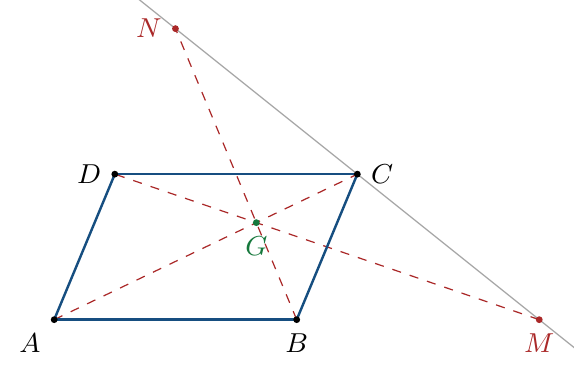
On considère un parallélogramme ABCDABCD et les points MM et NN définis par BM→=AB→etDN→=AD→.\overrightarrow{BM}=\overrightarrow{AB}\qquad\text{et}\qquad\overrightarrow{DN}=\overrightarrow{AD}.

  1. Faire une figure. [1 pt]
  2. Montrer que CM→=AB→−AD→\overrightarrow{CM}=\overrightarrow{AB}-\overrightarrow{AD} et que CN→=AD→−AB→\overrightarrow{CN}=\overrightarrow{AD}-\overrightarrow{AB}. [1 pt]
  3. En déduire que CC est le milieu de [MN][MN]. [0,5 pt]
  4. On considère le point KK défini par AK→=AM→+AN→\overrightarrow{AK}=\overrightarrow{AM}+\overrightarrow{AN}. Montrer que CC est le milieu de [AK][AK]. [1 pt]
  5. Montrer que les droites (BD)(BD) et (MN)(MN) sont parallèles. [1,5 pt]

Bonus [+0,5 pt]. On considère le point GG défini par AG→=23AC→\overrightarrow{AG}=\tfrac23\overrightarrow{AC}. Montrer que GG appartient à la fois à la droite (MD)(MD) et à la droite (BN)(BN).

Voir la correction

1) [1 pt] MM est le symétrique de AA par rapport à BB, et NN celui de AA par rapport à DD.

Figure

2) [1 pt] CB→=−AD→\overrightarrow{CB}=-\overrightarrow{AD} et CD→=−AB→\overrightarrow{CD}=-\overrightarrow{AB} (parallélogramme). Donc :

CM→=CB→+BM→=−AD→+AB→\overrightarrow{CM}=\overrightarrow{CB}+\overrightarrow{BM}=-\overrightarrow{AD}+\overrightarrow{AB} [0,5] ;  CN→=CD→+DN→=−AB→+AD→\ \overrightarrow{CN}=\overrightarrow{CD}+\overrightarrow{DN}=-\overrightarrow{AB}+\overrightarrow{AD} [0,5].

3) [0,5 pt] CM→+CN→=0⃗\overrightarrow{CM}+\overrightarrow{CN}=\vec0, donc CC est le milieu de [MN][MN] [0,5].

4) [1 pt] AM→=2AB→\overrightarrow{AM}=2\overrightarrow{AB} et AN→=2AD→\overrightarrow{AN}=2\overrightarrow{AD}, donc AK→=2(AB→+AD→)=2AC→\overrightarrow{AK}=2\left(\overrightarrow{AB}+\overrightarrow{AD}\right)=2\overrightarrow{AC} [0,5]. Ainsi AC→=12AK→\overrightarrow{AC}=\tfrac12\overrightarrow{AK} : CC est le milieu de [AK][AK] [0,5].

5) [1,5 pt] MN→=AN→−AM→=2AD→−2AB→\overrightarrow{MN}=\overrightarrow{AN}-\overrightarrow{AM}=2\overrightarrow{AD}-2\overrightarrow{AB} [0,5] =2(BA→+AD→)=2BD→=2\left(\overrightarrow{BA}+\overrightarrow{AD}\right)=2\overrightarrow{BD} [0,5] : vecteurs colinéaires, donc (BD)∥(MN)(BD)\parallel(MN) [0,5].

Bonus [+0,5 pt]. AG→=23AB→+23AD→\overrightarrow{AG}=\tfrac23\overrightarrow{AB}+\tfrac23\overrightarrow{AD}.

  • MG→=AG→−AM→=−43AB→+23AD→\overrightarrow{MG}=\overrightarrow{AG}-\overrightarrow{AM}=-\tfrac43\overrightarrow{AB}+\tfrac23\overrightarrow{AD} et MD→=−2AB→+AD→\overrightarrow{MD}=-2\overrightarrow{AB}+\overrightarrow{AD} : MG→=23MD→\overrightarrow{MG}=\tfrac23\overrightarrow{MD}, donc G∈(MD)G\in(MD).
  • BG→=−13AB→+23AD→\overrightarrow{BG}=-\tfrac13\overrightarrow{AB}+\tfrac23\overrightarrow{AD} et BN→=−AB→+2AD→\overrightarrow{BN}=-\overrightarrow{AB}+2\overrightarrow{AD} : BG→=13BN→\overrightarrow{BG}=\tfrac13\overrightarrow{BN}, donc G∈(BN)G\in(BN).

Exercice 3 — Projection — 3 points Facile ★★☆☆☆

On considère un triangle ABCABC et le point EE défini par CE→=14CB→\overrightarrow{CE}=\tfrac14\overrightarrow{CB}. On note FF le projeté de EE sur (AB)(AB) parallèlement à (AC)(AC), et JJ le projeté de EE sur (AC)(AC) parallèlement à (AB)(AB).

  1. Faire une figure. [0,5 pt]
  2. En utilisant une projection, montrer que BF→=34BA→\overrightarrow{BF}=\tfrac34\overrightarrow{BA}. [1 pt]
  3. a) Montrer que CJ→=14CA→\overrightarrow{CJ}=\tfrac14\overrightarrow{CA}. [0,5 pt] b) Montrer que AE→=AF→+AJ→\overrightarrow{AE}=\overrightarrow{AF}+\overrightarrow{AJ}. [0,5 pt] c) Quelle est la nature du quadrilatère AFEJAFEJ ? Justifier. [0,5 pt]
Voir la correction

1) [0,5 pt] Figure :
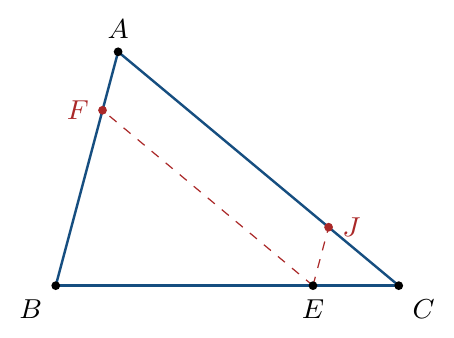
Figure

2) [1 pt] Projection sur (AB)(AB) parallèlement à (AC)(AC) : B↦BB\mapsto B, C↦AC\mapsto A, E↦FE\mapsto F [0,5]. Or BE→=BC→+CE→=34BC→\overrightarrow{BE}=\overrightarrow{BC}+\overrightarrow{CE}=\tfrac34\overrightarrow{BC}, donc BF→=34BA→\overrightarrow{BF}=\tfrac34\overrightarrow{BA} [0,5].

3) a) [0,5 pt] Projection sur (AC)(AC) parallèlement à (AB)(AB) : C↦CC\mapsto C, B↦AB\mapsto A, E↦JE\mapsto J. De CE→=14CB→\overrightarrow{CE}=\tfrac14\overrightarrow{CB} on tire CJ→=14CA→\overrightarrow{CJ}=\tfrac14\overrightarrow{CA}.

b) [0,5 pt] AF→=AB→+BF→=14AB→\overrightarrow{AF}=\overrightarrow{AB}+\overrightarrow{BF}=\tfrac14\overrightarrow{AB} et AJ→=AC→+CJ→=34AC→\overrightarrow{AJ}=\overrightarrow{AC}+\overrightarrow{CJ}=\tfrac34\overrightarrow{AC}. D’autre part, AE→=AC→+14CB→=AC→+14(AB→−AC→)=14AB→+34AC→=AF→+AJ→.\overrightarrow{AE}=\overrightarrow{AC}+\tfrac14\overrightarrow{CB}=\overrightarrow{AC}+\tfrac14\left(\overrightarrow{AB}-\overrightarrow{AC}\right)=\tfrac14\overrightarrow{AB}+\tfrac34\overrightarrow{AC}=\overrightarrow{AF}+\overrightarrow{AJ}.

c) [0,5 pt] D’après la règle du parallélogramme, AE→=AF→+AJ→\overrightarrow{AE}=\overrightarrow{AF}+\overrightarrow{AJ} signifie que AFEJAFEJ est un parallélogramme (les vecteurs AF→\overrightarrow{AF} et AJ→\overrightarrow{AJ} ne sont pas colinéaires, il n’est pas aplati).

← Retour aux chapitres TCS